

Custom 304 Stainless Steel Bird Aviaries
Explore 304 stainless steel bird cages made directly at the Bật Mạnh workshop.

Custom 304 Stainless Steel Bird Aviaries

Custom 304 Stainless Steel Bird Aviaries


Custom 304 Stainless Steel Bird Aviaries
60 × 40 × 60 cm Open-Frame 304 Stainless Steel Aviary Module


Custom 304 Stainless Steel Bird Aviaries


Lồng AVI chậu cây
Stainless steel bird cages Trên Chậu Cây Mái Hai Tầng 55 × 35 × 75 cm

Custom 304 Stainless Steel Bird Aviaries
Check the bird and usable measurements first
Use the documented cage as a starting point, then compare the bird, clear gaps, usable space, construction and daily-care layout.
Custom stainless steel bird aviaries made in Vietnam
International customers use “aviary” for several different products: a large indoor flight enclosure, a wheeled bird room, a covered-balcony cage, a modular walk-in system or a landscaped outdoor structure. Those uses require different floors, roofs, mesh, access doors and weather protection. Bật Mạnh therefore starts with the bird, the location and the daily care routine rather than applying one catalogue shape to every project.
The category contains four aviary-specific starting points. It also displays the existing 80 cm modular flight cage because that product is shared with the Vietnamese AVI collection. Price, images and availability remain linked to the original WooCommerce products; the English pages add a reviewed specification and explain what is confirmed, optional or still missing.
Compare the current Bật Mạnh aviary references
| Reference | Confirmed or documented data | Important limitation |
|---|---|---|
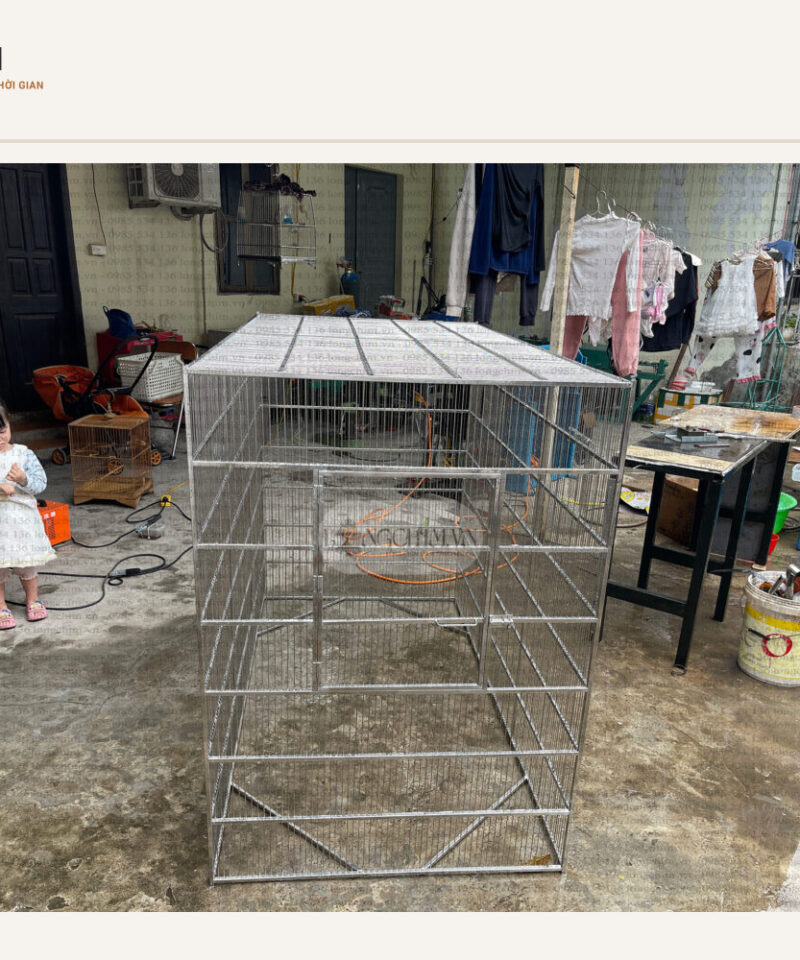
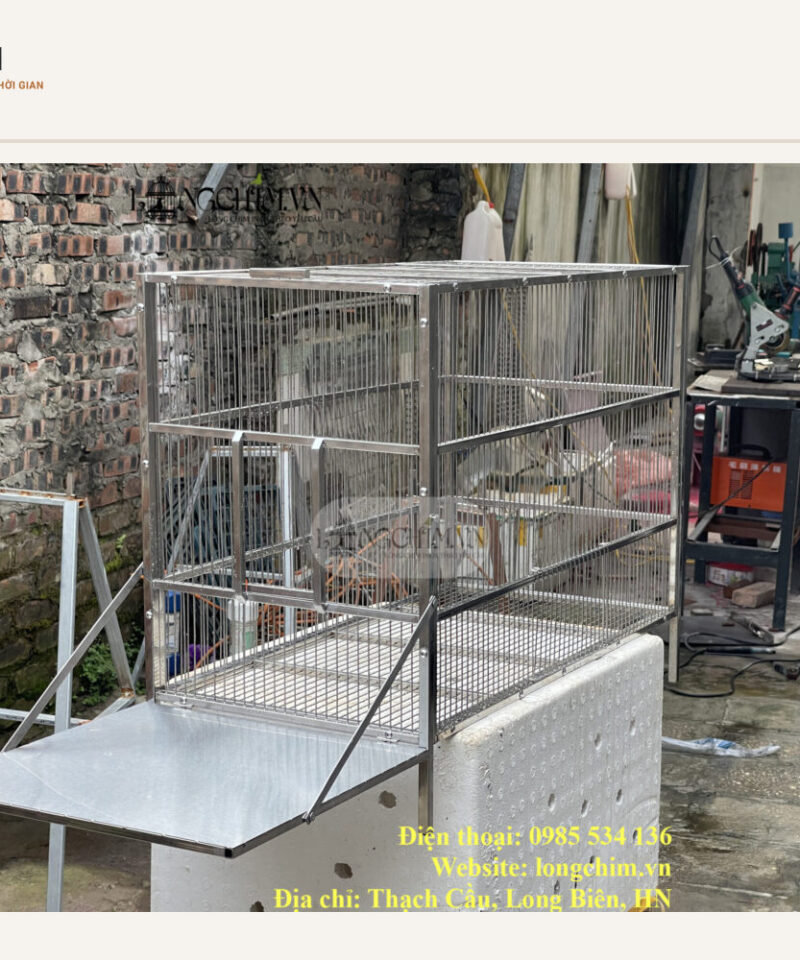
| 167 × 87 × 120 cm completed aviary | 304 stainless steel; external size 167 × 87 × 120 cm; approximately 10 × 10 mm square-tube frame; one large and two small doors; approximately 12 mm reference clear spacing; no legs and no waste or soil tray on the photographed build. | The bar diameter, usable interior and detailed door openings are not published. Bird compatibility must be checked again for a repeat order. |
| 62 cm wide × 115 cm high vertical aviary | Completed square-form reference in 304 stainless steel; approximately 62 cm wide and 115 cm high; stainless roof with a lining intended to help reduce heat transfer. | Depth, bar diameter, clear spacing, doors, tray and full external envelope must be confirmed. It is not described as 62 × 62 × 115 cm. |
| 60 × 40 × 60 cm open module | 304 stainless steel rectangular module made without a roof and without a floor for connection to an existing secure structure. | It is not a complete standalone bird enclosure. The receiving roof, floor, wall, fixings, gaps and cleaning route form part of the final safety review. |
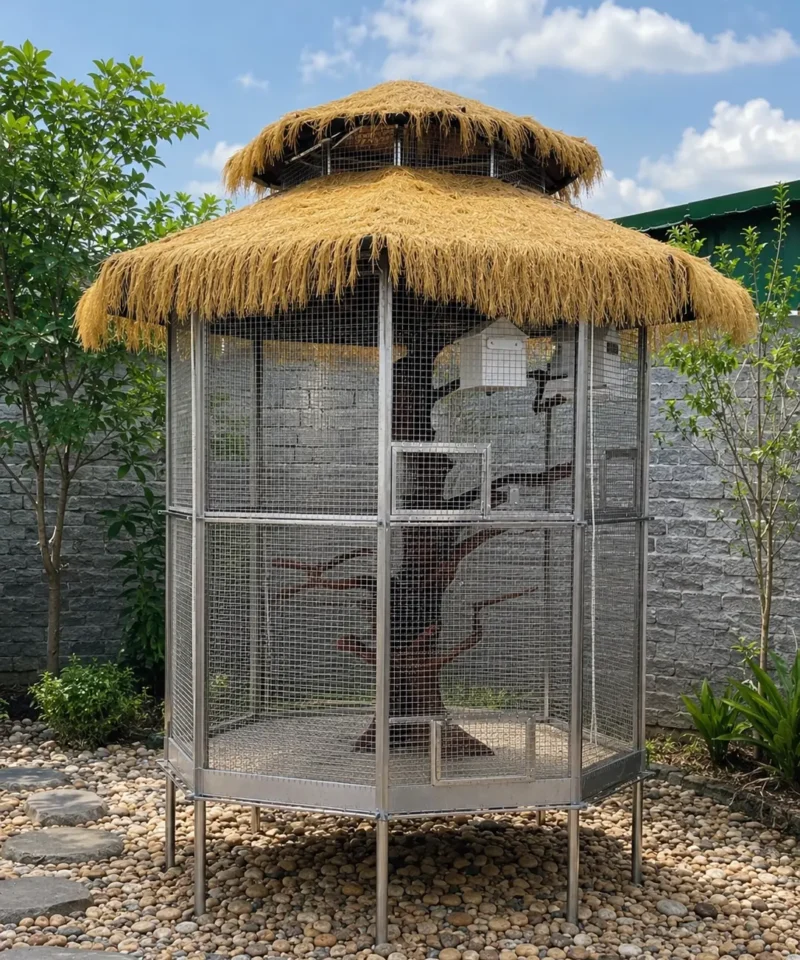
| Octagonal garden-aviary concept | Design proposal with an approximately 154 cm width, 166.6 cm diagonal, 180 cm body, 40 cm legs, 20 × 20 mm main frame, 18 × 18 mm reference mesh and a two-tier artificial-thatch roof. | These are proposal dimensions, not final acceptance measurements from a completed aviary. Structure, trays, doors, roof and installation must be engineered for the selected site. |
Start with species, quantity and intended use
An aviary should support the behaviour and body dimensions of the identified birds. Provide the accepted species name, quantity, adult wingspan and tail length, whether the birds can fly normally and whether the enclosure is for permanent housing, supervised daytime use, breeding, temporary separation or another defined routine. Mixed species also require a compatibility and resource plan; a larger floor area alone does not prevent conflict around food, water, nest sites or high perches.
Local welfare and wildlife rules remain the buyer’s responsibility. The RSPCA bird-environment guidance emphasises usable flight room, shelter from weather and escape control. The Animal Welfare Victoria code is one example of a jurisdiction-specific standard covering cage design, shelter, ventilation, drainage, predators and housing area. These references inform questions; they do not replace the requirements at the destination.
Overall dimensions, usable interior and flight path
External length, width and height determine whether an aviary fits the site and access route. Usable interior is smaller when the product includes a roof overhang, legs, tray housing, structural posts, internal partitions or a protected service area. A buyer should also record the clear horizontal movement path between principal perches. Height is useful for climbing and different perch levels, but it does not replace adequate length and depth.
Measure at least five envelopes: the maximum external aviary, the clear internal space, the operating area needed for doors and trays, the largest module or completed body carried through the property, and the packed shipment where export is required. See the external versus usable dimensions guide for a measurement worksheet.
Indoor, covered and outdoor aviaries need different specifications
| Location | Design priorities | Questions before fabrication |
|---|---|---|
| Indoor | Ventilation, floor protection, debris control, doors, tray removal, access around the enclosure and compatibility with room finishes. | Can every surface be cleaned? Is there enough room to open doors and remove trays without moving the complete aviary? |
| Covered balcony or veranda | Wind-driven rain, direct sun, drainage, secure anchoring, neighbour-facing debris control and corrosion exposure. | Which sides receive sun, wind and rain? Can acrylic or solid guards be used without restricting ventilation? |
| Outdoor garden | Weather shelter, shade, drainage, foundation, anchoring, predator and pest exclusion, double-door escape control and maintainable landscaping. | Is the roof and wall coverage suitable for the local climate? How will the floor edge, drains, mesh and service entries prevent escape or intrusion? |
A decorative roof does not by itself make an aviary suitable for year-round outdoor use. The final proposal must address the site’s prevailing sun, wind, rain, temperature range, standing water, salt exposure and storm loads. Bật Mạnh does not publish a universal wind rating, waterproofing claim or foundation detail for the four current references.
Bar diameter, mesh opening and every secondary gap
Solid bars, welded mesh and framed panels behave differently. Record the material, wire or bar diameter, clear opening, panel size, frame support and joint method. The clear opening must suit the identified bird; the same gap cannot be assigned automatically to finches, bulbuls, doves and parrots. Parrots also require a separate review of chewing force, panel strength, locks and bird-accessible fasteners.
The main field is not the only opening. Check door edges, feeder ports, tray guides, floor joints, roof transitions, module seams, drains and any gap between the aviary and an existing wall. For the 167 cm workshop model, approximately 12 mm is a reference from that completed order, not a universal recommendation. For the octagonal concept, approximately 18 × 18 mm describes the proposed mesh opening and still requires species confirmation.
Doors, service access and escape control
A large access door is useful for cleaning, carrying branches and retrieving equipment, but it also creates the largest escape opening. Confirm its clear width and height, swing direction, latch, lower threshold and the space required outside it. Smaller service doors can reduce how often the main door is opened, provided feeder cups and accessories cannot be pushed through an unsafe gap.
Walk-in outdoor aviaries should be discussed with a safety porch or double-door arrangement so that one door can close before the next opens. This feature is not included automatically in the four current product records. State it in the quotation, together with locks, hinges, door stops and any bird- or predator-resistant hardware.
Floors, trays and drainage determine daily workload
Compact indoor aviaries may use removable waste trays. Long bodies can benefit from divided trays that remain practical to lift and wash. A garden aviary may instead use a washable sealed floor, suitable substrate or site drainage designed for the birds and local conditions. The floor edge must meet the walls without leaving escape or pest routes.
The octagonal proposal uses four removable triangular tray directions; the 167 cm completed reference explicitly has no tray; the 60 cm open module has no floor. These three arrangements are not interchangeable. Confirm how waste, water and loose food will be removed before the frame is fabricated.
Fixed welded or modular construction
A fixed body reduces the number of site joints but must pass through every gate, doorway, corridor, stair and lift. A modular enclosure can reduce the largest carried component and simplify freight, yet its panel joints, floor alignment, roof support, fasteners and final rigidity require deliberate design. Large garden structures may also need local foundation or installation work outside Bật Mạnh’s product scope.
Measure the route before approving the construction. Use the large-cage access-route guide and compare welded versus modular construction.
Information needed for an aviary quotation
- Birds: species, quantity, adult size, flight ability and any special care requirement.
- Location: indoor, covered or outdoor; photographs; floor or wall construction; sun, wind, rain and drainage exposure.
- Dimensions: maximum external envelope, desired usable interior, door openings and access-route restrictions.
- Construction: fixed or modular body, bars or mesh, required clear opening, roof, floor, legs, wheels or anchoring.
- Daily service: main and feeder doors, trays or drainage, perches, bowls, bathing, nests, partitions and debris guards.
- Delivery: destination, postal code, packed-size restrictions, unloading and any local installation responsibility.
Use the indoor versus outdoor aviary planning guide and the custom quotation checklist before requesting a final configuration.
Frequently asked questions
Is every product in this category a complete aviary?
No. The 60 × 40 × 60 cm product is an open module without a roof or floor. It must be integrated into a secure, compatible structure. The octagonal item is a design proposal rather than a completed acceptance record.
Can the 12 mm spacing from the 167 cm aviary be used for any small bird?
No. It is a documented reference from one build. The bird’s head and body size, age, mobility and all secondary gaps must be reviewed for a new order.
Does 304 stainless steel make an aviary maintenance-free outdoors?
No. Stainless steel is corrosion resistant, not maintenance-free. Deposits, salt, chemicals, drainage, dissimilar-metal contact and the local environment affect inspection and cleaning requirements.
Can Bật Mạnh export a large aviary?
International enquiries can be reviewed, but the final module sizes, packaging, gross weight, freight method, duties, local foundation and installation scope must be confirmed per destination.
Request a custom aviary review
Email nguyenbatmanh@gmail.com, call +84 985 534 136 or message Bật Mạnh on Facebook. Include the bird species, quantity, installation photographs, target dimensions and destination.