

Stainless Steel Flight Cages
Explore 304 stainless steel bird cages made directly at the Bật Mạnh workshop.

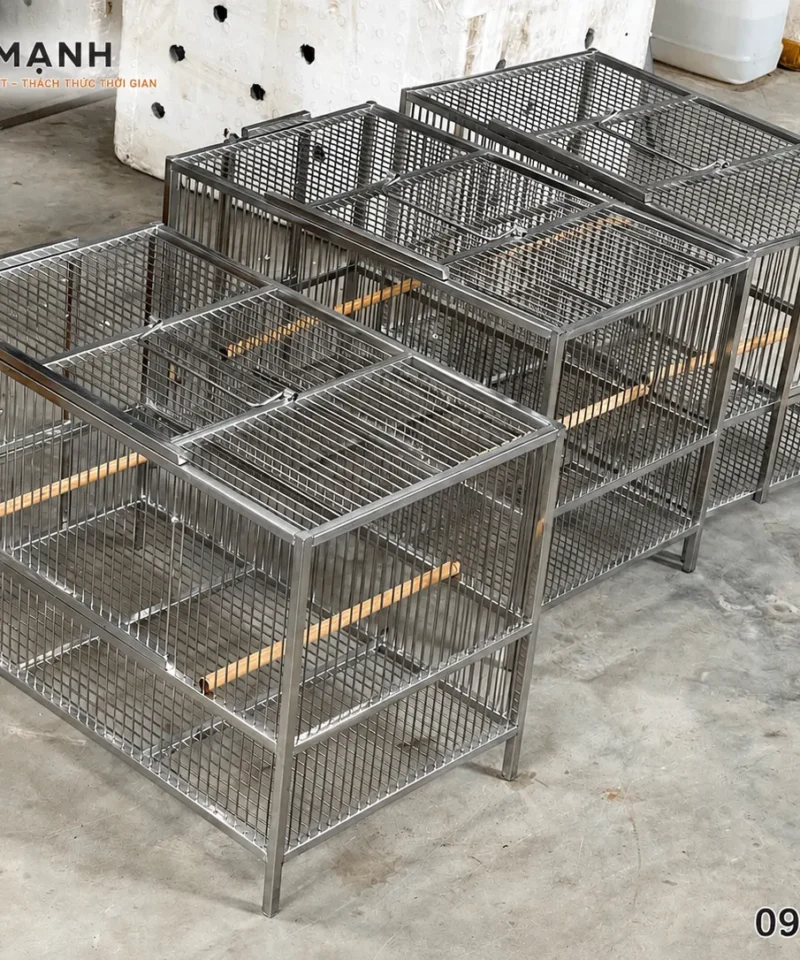


Stainless steel bird cages
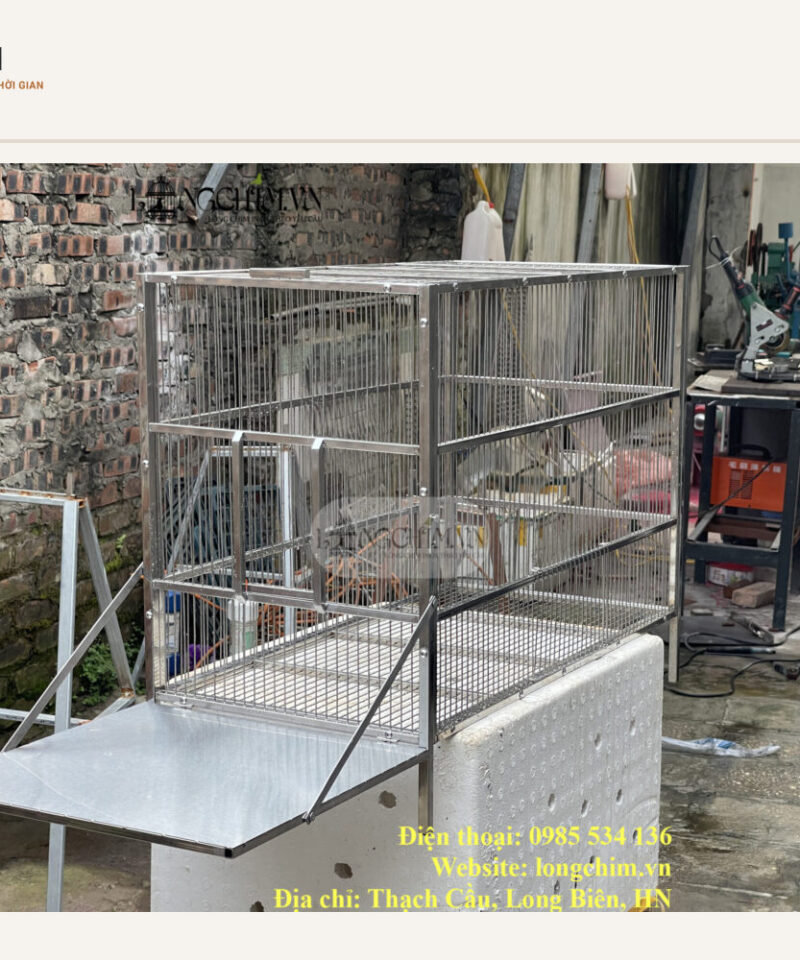

Stainless steel aviaries
Check the bird and usable measurements first
Use the documented cage as a starting point, then compare the bird, clear gaps, usable space, construction and daily-care layout.
What is a flight cage?
A flight cage gives a bird a longer, clear route between perches than a conventional compact cage. In Vietnam this format is often called a lồng lực. In English, flight cage is the clearest product term; “conditioning cage” can describe the intended use, while “aviary” is normally reserved for a substantially larger enclosure.
A flight cage does not guarantee fitness, behaviour or song quality. Its value depends on a suitable layout, safe bar spacing, sensible perch placement, daily care and the amount of time the individual bird spends inside it.
Compact, modular and extra-long configurations
| Configuration | Typical direction | Practical advantage | Planning note |
|---|---|---|---|
| Compact fixed cage | Approximately 50–80 cm long | A rigid welded body with straightforward cleaning and handling. | Best suited to one small bird when dimensions and bar spacing are confirmed for that species. |
| Modular flight cage | Approximately 80–200 cm long | Sections can be transported through smaller access routes and assembled at the destination. | Connections, doors, trays and supports must remain rigid after assembly. |
| Extra-long made-to-measure cage | Over 2 m; 2.5 m, 3 m or another agreed length | Creates a longer horizontal route for a defined bird room or covered area. | The number of modules and supports, floor level, cleaning access and delivery route are reviewed for each project. |
| Tall or vertical layout | Height prioritised where width is limited | Uses a narrow installation area more efficiently. | Perches should still form practical movement routes rather than simply filling the cage with obstacles. |
Common flight-cage lengths
These dimensions are reference starting points, not universal minimums or maximums. Final external dimensions must be checked against the bird’s body size, wingspan, tail length, activity, number of birds, time in the cage and available installation space.
| Reference length | Typical planning direction | Construction note |
|---|---|---|
| 50 cm | Compact cage for white-eyes, sunbirds and similarly small birds, subject to species confirmation. | A fixed welded frame is compact and easy to handle. |
| 60–70 cm | More separation between two main perches while keeping the cage portable. | Door and feeder positions should not interrupt the central movement path. |
| 80 cm | A practical modular format for small and medium songbirds. | Bar spacing and internal height must be confirmed before fabrication. |
| 100–120 cm | A longer home flight cage with greater horizontal clearance. | Modular construction can simplify transport and cleaning. |
| 150–180 cm | Long cage for a dedicated bird area or covered balcony. | Additional frame support and divided waste trays may be useful. |
| 200 cm | Two-metre made-to-measure layout. | Access doors, tray sections and assembly joints need to be planned together. |
| Over 200 cm | 2.5 m, 3 m and other project-specific lengths. | Usually divided into manageable modules; the site, floor, access route and support arrangement are reviewed before production. |
Planning by bird type
| Bird group | Useful design direction | Details to confirm |
|---|---|---|
| White-eyes and sunbirds | Compact horizontal cage with fine bar spacing and clear feeder access. | Head size, bar spacing, feeder type and door gaps. |
| Bulbuls | More body and tail clearance with a practical route between perches. | External dimensions, perch height, tail clearance and door position. |
| Shamas and thrushes | Horizontal movement space with enough depth and a tray that is easy to clean. | Tail length, preferred perch levels, bathing area and bar spacing. |
| Other small and medium songbirds | Species-specific dimensions rather than one standard cage for every bird. | Adult size, strength, behaviour, number of birds and supervised versus full-time use. |
The final recommendation is made for a clearly identified bird. Similar common names can refer to birds with different body sizes and behaviours, so a photograph and the accepted Vietnamese or scientific name are useful when requesting a custom cage.
Bar spacing, bar diameter and door gaps
Bar spacing is a safety specification, not a styling choice. It should reduce the risk of escape, head entrapment or a foot becoming caught. The workshop also reviews the gap around doors, feeder openings and removable trays. Bar diameter and lock strength are selected for the bird’s size and beak strength.
Current Bật Mạnh examples use approximately 10 mm spacing on the 50 cm white-eye and sunbird cage, approximately 12 mm on an 80 cm modular cage, and approximately 10–14 mm on custom modular projects. These are product references only. The agreed spacing is reconfirmed before a new cage is fabricated.
Perches should preserve the movement path
Two principal perches are normally positioned to encourage practical movement without forcing the bird’s tail against the frame. Too many perches, feeders or toys can obstruct the very space the longer cage is intended to provide. Perch diameter, surface and orientation should be appropriate for the bird, with food and water kept clear of the main waste path.
Fixed welded or modular construction?
- Fixed welded construction provides a rigid one-piece body and suits compact cages that can pass through the intended doorway.
- Modular construction is useful for longer cages, narrow stairs, apartment lifts and projects that may need to be moved later.
- Made-to-measure modules allow lengths beyond 120 cm—including 150 cm, 180 cm, 2 m, 2.5 m and 3 m—without treating one large panel as a portable unit.
For every modular cage, the joint design, fasteners, alignment, tray movement and support points must be checked after assembly. A modular cage should not depend on loose or bird-accessible fasteners inside the enclosure.
Cleaning and daily access
Front service doors, separate feeder access and removable stainless steel waste trays can be arranged to suit the installation. Long cages may use divided trays so that each section remains practical to remove and wash. Smooth bird-contact edges, protected bar ends and secure door locks are checked as part of the fabrication process.
Current Bật Mạnh flight cages
- 50 cm flight cage for white-eyes and sunbirds: a compact fixed 304 stainless steel model with 10 mm reference bar spacing.
- 80 cm modular stainless steel flight cage: an approximately 80 × 38 × 50 cm configuration with 12 mm reference bar spacing.
- Custom modular stainless steel flight cage: made to the agreed dimensions, from compact formats to lengths over 2 m.
Frequently asked questions
Is a flight cage the same as an aviary?
Not usually. A flight cage is a cage format that prioritises a longer movement route. An aviary is generally a much larger enclosure, often designed for people to enter or for several birds to occupy.
Are Bật Mạnh flight cages limited to 120 cm?
No. We can review 150 cm, 180 cm, 2 m, 2.5 m, 3 m and other made-to-measure lengths. Longer cages are normally divided into modules suitable for the access route, installation area and cleaning plan.
Can one bar spacing be used for every songbird?
No. Bar spacing and door gaps must be matched to the specific bird. The dimensions shown on existing products are references for those configurations, not a blanket recommendation for every species.
Can the cage be made taller instead of longer?
Yes, where the installation area requires it. However, perch placement must still create useful routes and enough body and tail clearance. More height alone does not replace appropriate horizontal room for birds that move mainly from side to side.
What information is needed for a custom quotation?
Please send the bird species and quantity, target length × depth × height, a photograph of the installation area, preferred construction (fixed or modular), tray direction, door requirements and delivery location.
Request a flight-cage quotation
Email nguyenbatmanh@gmail.com, call +84 985 534 136 or message Bật Mạnh on Facebook. Please identify the bird and intended use so that we can review dimensions, bar spacing, construction and transport together.